
It’s news to no one that creative does the targeting now. It's been the biggest shift in Meta advertising over the past 12-18 months, and it isn't going anywhere in 2027.
To be fair to Google, it got there first. Performance Max has been finding your audience from your assets, product feed and website since it launched. Shopping has always depended on the quality of your feed. AI Max is now doing the same to Search, matching you to queries based on your landing pages and ad copy, not just the keywords you chose. ChatGPT ads, now live in the UK, were built this way from the start. They match your ad to the conversation someone is having, so the words in your ads and on your site do the job that keywords and interest targeting used to do.
Wherever you advertise in 2027, what you give the platform decides who sees you.
So at the heart of any 2027 creative strategy is one question, ‘How does a small team keep producing the right creative, month after month, without a studio or the budget for 50 new ads a week?’. This article is for founder-led businesses with small teams who care about the authenticity of their brand and know they need a steady flow of creative, made as simply as possible.
We've highlighted the five things we’ve seen D2C brands struggle with the most in 2026, and how to address them.
1. "MY WINNING AD HAS STOPPED WORKING, AND I DON’T HAVE A REPLACEMENT"
Every ad fades eventually. The problem isn't that your winner has stopped working, it's that nothing was ready to replace it.
Meta describes creative fatigue simply - your audience has seen the same ad too many times, so engagement drops and costs rise. You'll usually see:
Frequency on the ad rise
Click-through rate slide
Cost per purchase rise, even though your CPMs haven't moved much
What to do in 2027:
Treat having one winner as a liability! If one ad is carrying most of your spend, your account is relying too heavily on one asset.
Always have the next idea in testing before the current winner fades. New creative needs time to find its feet, so start it while the winner is still doing well.
Don't refresh a tired ad with minor tweaks. A new headline or a different background colour on the same asset won't fix fatigue. Meta's own advice is to rotate genuinely distinct creative. If an idea has worked, rebuild it as a new concept, e.g. a different person telling the same story, or the same benefit shown from a different angle.
2. "MY AGENCY KEEPS ASKING FOR MORE CREATIVE, AND I CAN’T KEEP UP"
You might not need more ads. The volume that counts is the volume of ideas and angles, not more versions of the same ad. Getting more ideas doesn't need a bigger production budget, it needs planning.
What to do in 2027:
Count concepts, not ads. For most small brands, three to five genuinely new concepts a month is a realistic, sustainable target, and they will cover more ground than 30 variations of the same idea.
Brief by concept. Before listing the formats you need, decide what's changing in each ad; a new angle, a different person, a different audience, a new moment of use, or a new kind of proof. The table in the next section gives you the options.
Get several concepts from each shoot. Even with one person in front of the camera, a well-planned shoot can cover several concepts by changing the moment, the angle and the proof, e.g. a morning routine, a travel or gym-bag moment, a close-up demo, and an answer to a common objection.
Start with what you already have. Customer reviews, press quotes, founder interviews and the content customers already post about you are all raw material. A strong review can become a text-led ad and a founder Q&A can become a talking-to-camera piece.
Build a small group of creators. A handful of people you work with regularly is the quickest way to put a different person, and a different audience, in front of the camera without organising a shoot each time.
3. "OUR ADS ALL LOOK THE SAME"
If your ads look alike to you, they look alike to Meta, and it treats near-identical ads as one.
There's a difference between an asset and a concept:
An asset is a single file - a 9:16 video, a 1:1 static, a version with a different headline.
A concept is a genuinely different ad - a new angle, a different person, a different audience or moment, or a new kind of proof.
Ten resizes of one video is one concept. If your team is producing variations to keep the account "fresh", much of that effort may be invisible to the algorithm.
This catches out brands with a strong visual identity: the same product shot, the same palette and the same layout, ad after ad. That consistency is good for your brand, but it limits who Meta can find for you.
The simplest way to get genuinely different concepts is to vary four building blocks.
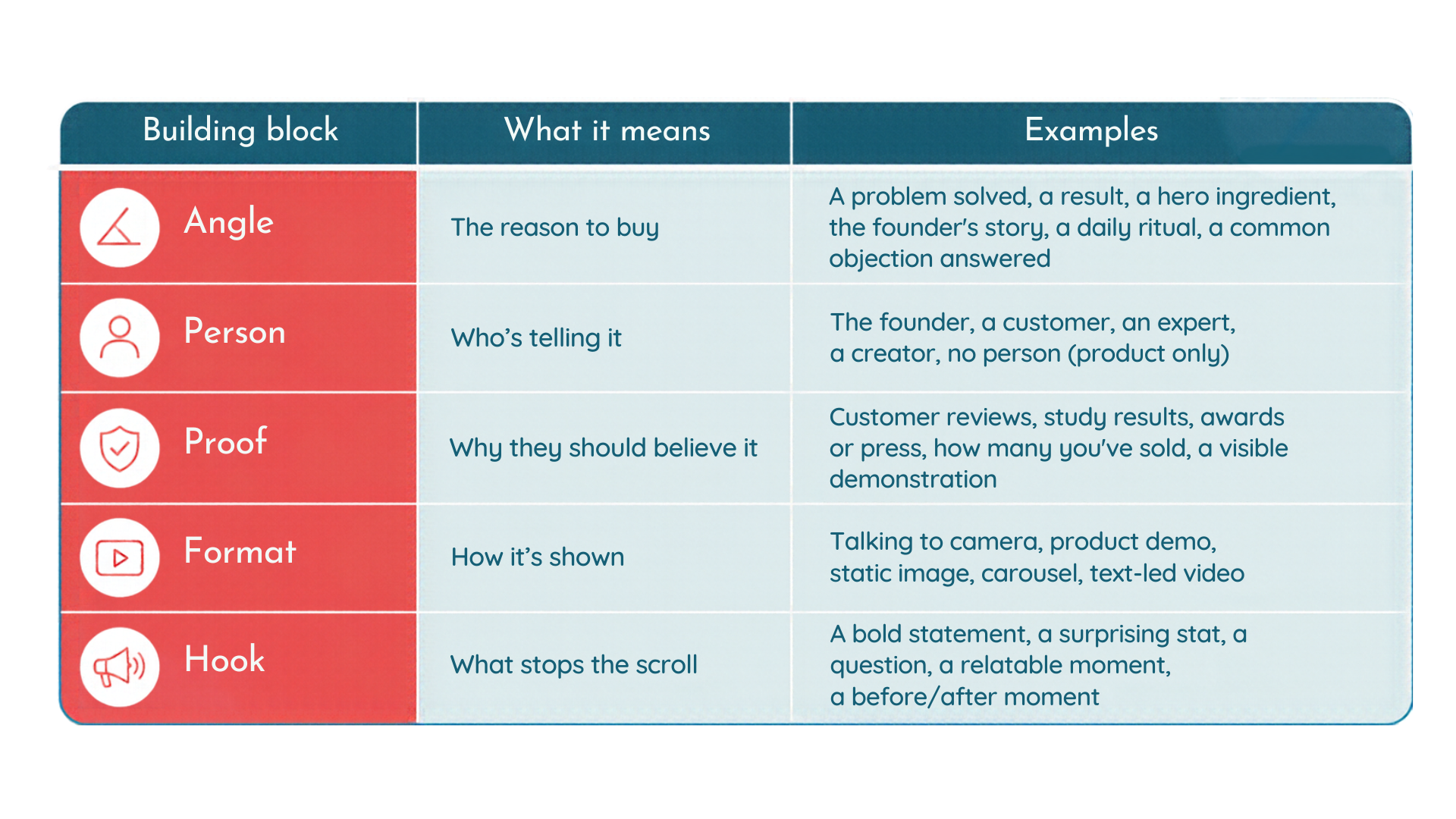
The rule of thumb - a new concept changes at least two of the four. The same founder telling the same story in a carousel instead of a video is a variation. A customer explaining the problem it solved for her, backed by reviews, is a new concept.
Keep your brand consistent across all of them: same tone of voice, same standards, same look and feel where it matters. Distinct ideas don't mean an inconsistent brand. They reflect the fact that your customers aren’t all the same.
4. "WE WON’T USE AI-GENERATED ASSETS”
If you've held back from AI-generated ads because they don't feel right for your brand, that’s not a weakness. In 2027, that may become more of an advantage.
Both Meta and Google now offer built-in tools that generate images, backgrounds, animations and even full videos from your existing assets. Plenty of brands use them, which means feeds will fill with more of the same polished, generic creative. Real founders, real customers and real product in use will stand out more, not less.
AI-generated creative is also becoming visible to your customers:
Meta can add an "AI info" label to ads created or significantly edited with its own generative tools, and with some third-party tools that leave detectable metadata.
If an ad features a photorealistic AI-generated person, that label can appear right beside "Sponsored" in the feed.
For beauty, wellness and fashion brands, where trust is a big part of what customers are buying, that's something worth considering.
What to do in 2027:
Keep real people for anything that asks for trust: testimonials, before-and-afters, founder stories.
Use AI where nobody’s pretending, such as resizing, subtitles, cutdowns and background clean-up.
If you do test AI-generated creative, check the “About this ad” menu to see whether it’s been labelled, and judge results against your real-person ads, not in isolation.
5. "OUR CREATIVE EFFORT GOES INTO META, GOOGLE JUST TICKS ALONG IN THE BACKGROUND”
Most brands don’t see this as a problem, but we do! Saving your best creative for Meta and leaving Google to run off the product feed and whatever images are to hand is going to get more expensive in 2027. Your feed, your website and your video are what Google uses to decide where you appear.
Three changes that will matter for small to mid e-commerce brands in 2027
Search is going broad. Since September, Google has been automatically moving campaigns using Dynamic Search Ads, automatically created assets or campaign-level broad match over to AI Max. AI Max matches your ads to a wider range of searches and can tailor your ad text using your landing pages. In practice, the words on your product pages are becoming your ad copy.
Video is now central. In Demand Gen, Google's campaign type for YouTube and its other visual placements, short video has become the main format. Performance Max uses video too. If you don't give Google good video, you're leaving it to work with whatever it can find or build.
You can finally test creative in Performance Max. Google now lets you run experiments comparing different sets of assets, for example new creative against your current set. It's worth asking whoever runs your account whether they're using it, rather than assuming what works on Meta will work on Google.
And then there’s ChatGPT. ChatGPT ads are now live in the UK, and businesses can run them through OpenAI’s self-serve Ads Manager beta. Ads sit below ChatGPT’s answer and are matched to what the conversation is about. That makes it the clearest example of everything in this section …the more plainly your ads and product pages say who the product is for and what it solves, the more relevant conversations you can show up in. It’s early, and costs per click are jumpier than Google or Meta but we’re in the beta and have seen some really positive results. For brands new to this, treat it as a test, not a budget shift.
What to do in 2027:
Read your product pages as if they were ads. If a line would make you wince in an ad, it shouldn't be on the page.
Treat your feed as creative. Product titles and main images are the first thing a Shopping shopper sees. Clear, descriptive titles and clean, consistent images do more than most bid changes.
Reuse your best Meta concepts on Google. A talking-to-camera video that works on Instagram can often work on YouTube Shorts and Demand Gen too. Supply it in both vertical and horizontal versions.
FIVE QUESTIONS TO ASK WHOEVER RUNS YOUR ADS
You don't need to be in the platforms yourself to know whether your creative is ready for 2027. Ask your agency or in-house team the following:
How many genuinely different concepts (not resizes or headline swaps) have we run in the last 30 days?
Is one ad carrying most of our Meta spend, and what replaces it when it fades?
What's next in testing, and when does it go live?
What video do we have running on Google and have we looked at ChatGPT Ads?
Is our product page copy good enough to be quoted in an ad?
If you'd like a second pair of eyes on your creative and how it's working across Meta and Google, book a call with us. We'll tell you honestly what we'd change, and what we'd leave alone.