
Beyond Black Friday: What Your Discount Strategy Costs You Next Year
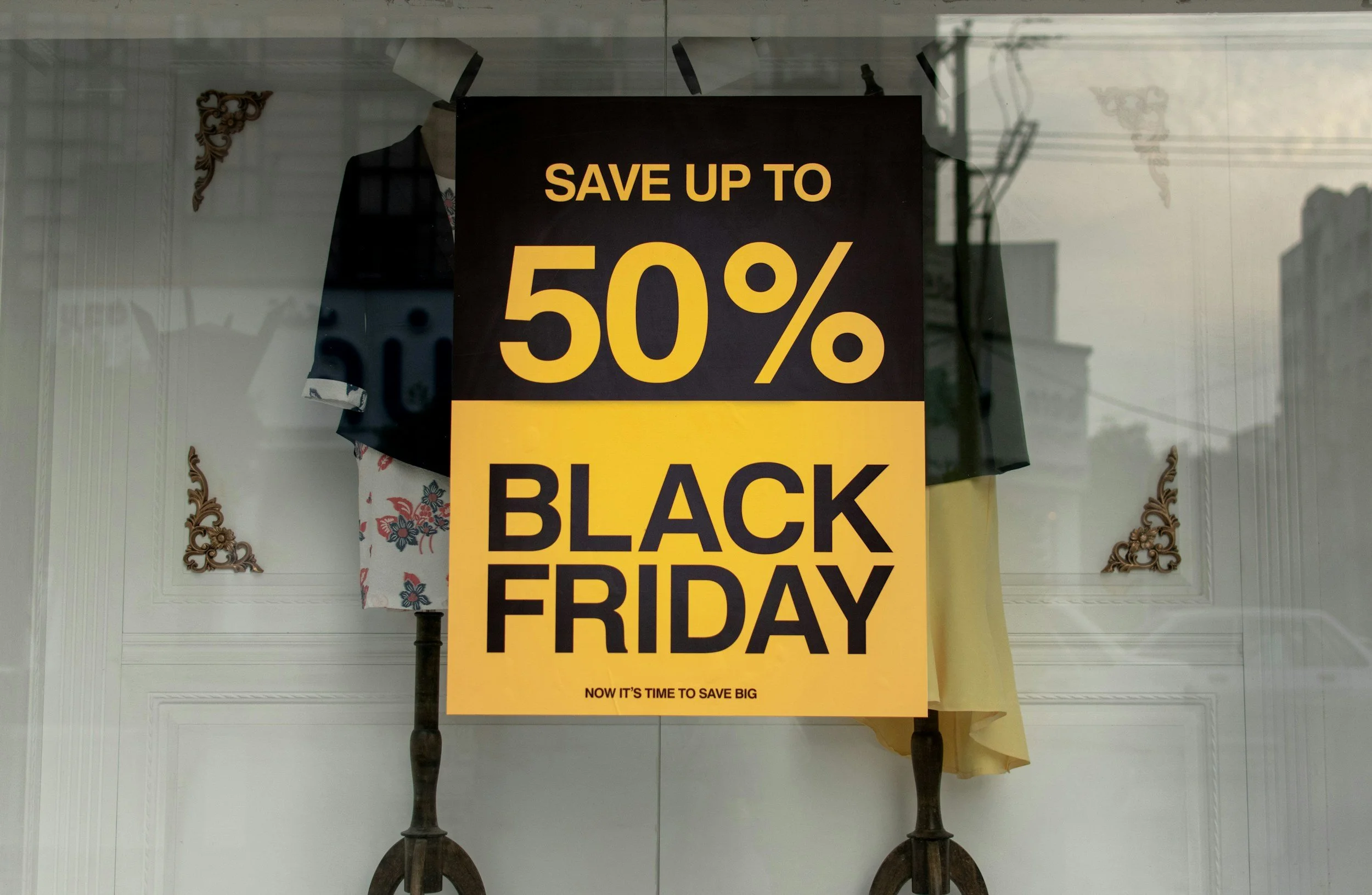
When we speak to brands we often find that too much Black Friday planning stops at Black Friday. They map out the offer, creative, budget pacing, landing pages, all pointing at a discount period in November, but not everybody maps out what that offer trains their customers to expect for the following twelve months.
That's what we ask brands to think about now, while the discount depth is still up for discussion.
IT’S NOT THE DISCOUNT, IT’S THE REPETITION
A single deep discount on its own doesn't necessarily do long term damage. The problem is predictable repetition. A brand that runs and open 40% off in November, 25% off in March, and 30% off in June isn't just running three promotions, it's teaching its customer base one lesson, over and over - full price is the price you pay if you’re not paying attention.
Once that lesson’s learned, it doesn't go back. Customers who bought at 40% off and then 25% off don't suddenly value the product at full price. They wait, and a customer base trained to wait is a customer base that quietly resets your baseline conversion rate for every campaign that isn't running an offer.
WHERE IT STARTS TO SHOW
November numbers will more than likely look strong, but it starts appearing in the campaigns you run afterwards, when the same audience that converted happily at 40% off, and again at 25% off sees a full-price product and sits tight. It shows up by the blended CPA creeping upward, not because targeting has got worse, but because a larger share of your list has reclassified itself as "will buy, but only on promo." It comes up in the conversations agencies and founders have every Q1 about why performance "dropped".
The revenue was real, but the buying pattern it created with your new customers was not accounted for.
THIS IS NOT AN ARGUMENT AGAINST DISCOUNTING
Discounting works, particularly for new customer acquisition. The distinction is between a discount that's part of a structure - a defined first-purchase offer, a clear reason it exists, a plan for what happens after, and a blanket markdown applied to everyone and repeated every time the calendar gives you a reason to run one. The first can build a new customer relationship, but the second just teaches your customers to only buy on promo.
WORTH DECIDING NOW, NOT IN NOVEMBER
If you're planning your Black Friday offer, the useful question isn't "what will convert best on the day", almost any deep discount will do that. It's whether this is the third or fourth time you've offered this exact audience a blanket markdown this year.
Are you selling repeat buy consumables such as supplements, condiments or beauty products? If a customer buying three of something at 40% off gets them through to your next predictable sale, they've opted out of ever paying full price again. Not because they excessively stockpiled, but because they can be confident when the next discount is coming. Work out your product's real usage rate against your own promo calendar, if your best customers can time their way around full price indefinitely, that's not loyalty, it's playing the system, and you are allowing it to happen.
SHOULD YOU CAP THE NUMBER OF OFFERS YOU RUN A YEAR?
The cap question isn't really "how many offers a year", it's what the objective of those offers is. If a quarterly promo exists because you're chasing a genuine influx of new customers, that's a deliberate acquisition strategy, but it's hard to run without your existing customers noticing and adjusting their own behaviour around it. Concentrating that strategy into one predictable event a year, then pulling back hard for the rest of it and putting the effort into converting that cohort into repeat buyers or subscribers rather than re-discounting them, is one way to contain the damage, although it does put a lot of weight on one event going well.
However, if the honest answer is that sales are running every three months because revenue is slow and a strong offer is the fastest lever to lift your month’s income, the discount isn't the problem. It’s a question that needs a considered answer, ‘Are you having a sale every three months because you need the lift, and if so, is the real problem somewhere else?’. Retention, pricing, conversion rate and AOV are all areas to review.
Whichever it is, there's one number worth watching either way. Start tracking full-price conversion rate among repeat customers now, so by January you've got a real baseline to check against, rather than a BFCM ROAS figure that tells you nothing about what happened next.
None of this is a case for going smaller in November. It's a case for not treating the discount as a default, but as part of your acquisition and retention strategy that you’re in control of.
If you’re still deliberating over your BFCM offer and want to talk through how it’s going to impact 2027, we’d be really happy to talk through the strategy with you. You can book a call below.